- No products in the cart.















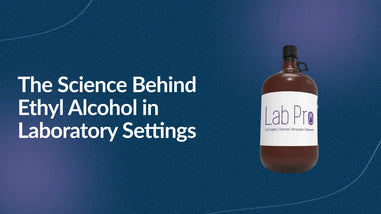
Walk into virtually any laboratory, whether pharmaceutical, analytical, microbiological, or research, and you'll find ethyl alcohol among the most frequently used chemicals.
Its molecular simplicity, just two carbons, five hydrogens, and one hydroxyl group (C₂H₅OH), masks a remarkably complex set of chemical behaviors that make it indispensable across diverse applications.
Yet many laboratory professionals use ethanol daily without fully appreciating the underlying chemistry that governs its effectiveness.
Understanding the science behind ethanol transforms it from a routine reagent into a precisely wielded tool, enabling researchers to optimize protocols, troubleshoot problems, and make informed decisions about when ethanol is the appropriate choice.
This article examines the molecular properties, chemical behavior, and scientific principles that explain why ethanol occupies such a prominent position in laboratory settings.
Key Takeaways:
-
Ethyl alcohol’s effectiveness is driven by its molecular structure and amphiphilic nature.
-
Purity, concentration, and storage conditions directly affect performance and reliability.
-
A 70% ethanol solution provides optimal antimicrobial activity for disinfection.
-
Environmental factors like temperature, humidity, and airflow influence evaporation and safety.
-
Ethanol offers a favorable safety and environmental profile compared to many lab solvents.
Molecular Structure and Chemical Properties

Ethyl alcohol (ethanol) is a primary alcohol composed of a two-carbon ethyl group and a hydroxyl (–OH) group. This structure confers both polar and nonpolar properties on ethanol: the hydroxyl group enables hydrogen bonding with water and other polar compounds, whereas the ethyl group imparts hydrophobic character. This amphiphilic nature allows ethanol to dissolve a wide range of substances, making it highly versatile in laboratory applications.
Its physical properties reflect this structure. Ethanol boils at 78.37°C due to hydrogen bonding, has a density of 0.789 g/mL at 20°C, and a refractive index of 1.361.
Its relatively high vapor pressure supports rapid evaporation. Compared to methanol and isopropanol, ethanol balances lower toxicity, effective solvency, and manageable evaporation, making it a common choice for many laboratory tasks.
Solvent Properties And The Science Of Dissolution
Ethanol's effectiveness as a laboratory solvent stems from its balanced polarity and molecular structure. Its ability to interact with both polar and nonpolar compounds allows it to dissolve a wide range of substances, making it valuable in extraction, cleaning, formulation, and analytical applications.

Also, read:
Antimicrobial Action: The Chemistry Of Disinfection
Ethyl alcohol disinfects by denaturing proteins and disrupting cell structures. It disrupts hydrogen bonds and hydrophobic interactions that maintain protein structure, causing enzymes and structural proteins to unfold and lose function. This process halts metabolism and leads to irreversible microbial death.
A 70% ethanol solution is more effective than higher concentrations. Water slows evaporation, improves penetration into cells, and prevents rapid surface protein coagulation that can block deeper action. This allows thorough protein denaturation throughout the cell and provides sufficient contact time for disinfection.
It also damages cell membranes by inserting into phospholipid bilayers, increasing permeability, and causing leakage of cellular contents. It is effective against most bacteria, fungi, and many enveloped viruses, but not against bacterial spores, which resist penetration by alcohol.
Compared with isopropanol, ethanol acts via similar mechanisms, with differences primarily in evaporation rate and lipid solubility rather than overall safety or effectiveness.
Purity Grades And Specifications
Ethanol is available in multiple purity grades, each designed for specific laboratory applications. Selecting the appropriate grade is essential to ensure experimental accuracy, regulatory compliance, and compatibility with analytical or biological workflows. Even slight differences in water content or trace impurities can affect results, particularly in sensitive procedures.

Physical Behavior In Laboratory Conditions
Environmental conditions, including temperature, airflow, and humidity, strongly influence the behavior of ethanol in the laboratory. These physical factors affect evaporation, moisture absorption, flammability, and material compatibility, all of which directly impact safety, reproducibility, and experimental accuracy during routine use.
Evaporation & Moisture
-
Evaporates quickly; small volumes dry in minutes
-
Evaporation causes cooling, which can affect temperature-sensitive work
-
Absorbs moisture from air; open containers dilute toward 95.6%
-
Humid environments increase water uptake
-
Use tight seals or molecular sieves for dry applications
Temperature Effects
-
Higher temperature lowers density and viscosity
-
Vapor pressure rises rapidly with heat, increasing evaporation and fire risk
-
Reaction rates change with temperature; control improves reproducibility
Flammability & Vapors
-
Flash point ~13°C; vapors are flammable at room temperature
-
Flammable range: 3.3%–19% in air
-
Vapors are heavier than air and collect in low areas
-
Autoignition at ~363°C; hot equipment can pose an ignition risk
Material Compatibility
-
Compatible: glass, stainless steel, aluminum, HDPE, PTFE, polypropylene
-
Incompatible: PVC, polystyrene, some rubbers
-
Degradation can cause contamination or seal failure
Stability & Degradation
-
Stable in sealed containers at room temperature
-
Air and light cause slow oxidation to acetaldehyde and acetic acid
-
Store cool, limit air exposure, use amber containers
Understanding how ethyl alcohol responds to laboratory conditions allows researchers to anticipate risks, control variability, and select appropriate storage and handling methods. By accounting for its volatility, moisture sensitivity, and vapor behavior, laboratories can maintain safer work environments while preserving consistency across experimental workflows.
Analytical Applications And Detection
Ethanol is widely used in analytical chemistry owing to its polarity, volatility, and optical properties, which enable reliable separation and detection. In liquid chromatography, it serves as a mobile-phase component or modifier, particularly in reversed-phase HPLC, where it modulates retention and selectivity while exhibiting low toxicity and good UV transparency. In gas chromatography, it is commonly analyzed as an analyte or used as a solvent, with routine applications in blood alcohol testing, fermentation monitoring, and quality control.
Ethyl alcohol is also used in TLC solvent systems to tune polarity and improve separations, and in spectroscopy due to its UV cutoff near 210 nm and stable refractive index. Deuterated forms are used in NMR when compounds are insoluble in common solvents.
As an internal standard, it helps correct for injection and instrumental variability when it is clearly resolved. Detection methods include enzymatic assays, dichromate oxidation, and gas chromatography, with GC offering the highest accuracy and sensitivity across most applications.
Environmental And Safety
Ethanol degrades rapidly in the environment, giving it a favorable safety and environmental profile. Microorganisms rapidly metabolize it to acetaldehyde, which is then converted to acetic acid, which ultimately yields carbon dioxide and water. This biodegradation occurs within hours to days, preventing persistence or bioaccumulation. Aquatic toxicity is relatively low, with harmful effects observed only at very high concentrations, which are unlikely to result from routine laboratory use.
In humans, it follows similar metabolic pathways and acts primarily as a central nervous system depressant. Acute toxicity is low relative to many laboratory solvents, as reflected by its high LD and OSHA’s relatively permissive exposure limit of 1,000 ppm. While high vapor levels can cause irritation or drowsiness, its overall risk profile is lower than that of alternatives such as methanol or benzene. Ethanol's GRAS status, renewable production, biodegradability, and more straightforward disposal make it a preferred choice for laboratories focused on safety and sustainability.
Ethyl alcohol’s widespread use in laboratory settings is rooted in well-defined chemical and physical principles rather than convenience alone. Its molecular structure enables broad solvent compatibility, effective antimicrobial action, and predictable behavior under varying laboratory conditions. When factors such as purity, concentration, temperature, and environmental exposure are properly understood and controlled, ethanol becomes a precise and reliable tool across analytical, biological, and research workflows. Applying this scientific understanding enables laboratories to improve reproducibility, maintain safety, and make informed decisions about when ethanol is the most appropriate choice and when alternative solvents may better serve the application.
Lab Pro supports laboratories with high-quality reagents, solvents, PPE, and equipment designed to meet the demands of modern scientific work. Our product range supports applications across molecular biology, analytical chemistry, and routine laboratory operations, with an emphasis on consistency, purity, and reliability.
In addition to core laboratory supplies, Lab Pro offers Vendor Managed Inventory (VMI) services to help laboratories maintain optimal stock levels and reduce supply disruptions. By automating replenishment and improving inventory visibility, VMI allows research teams to focus on experimental work rather than procurement logistics.
Enhance your lab with solutions built for precision and reliability.
Explore Lab Products
FAQs
Why does ethyl alcohol absorb water from the air, and why does it matter?
Ethanol is hygroscopic, meaning it readily absorbs moisture from the atmosphere. Over time, this reduces solvent purity and can affect reactions that require precise concentrations or dry conditions. Moisture uptake may alter solubility, reaction rates, or analytical accuracy, making proper sealing and storage essential for consistent results.
When should ethyl alcohol be avoided as a laboratory solvent?
Ethanol should be avoided in the presence of strong oxidizers, moisture-sensitive reagents, or reactions requiring inert conditions. It is ineffective against bacterial spores and unsuitable when ethanol interferes with detection methods or acts as a contaminant. In these cases, alternative solvents or sterilization methods are more appropriate.
How does ethanol’s amphiphilic nature affect solubility outcomes?
Ethanol’s polar hydroxyl group and nonpolar ethyl group allow it to dissolve many compounds. This versatility is functional but can cause partial solubility or co-extraction of impurities in complex samples. Understanding this balance helps researchers select conditions that maximize selectivity and avoid unintended dissolution.
Does storage time affect the chemical quality of ethanol?
Yes. While generally stable, prolonged exposure to air and light can slowly oxidize ethyl alcohol to acetaldehyde and acetic acid. This leads to off-odors and increased acidity. Using airtight, amber containers and minimizing headspace helps preserve solvent quality during extended storage.
Why is ethanol considered safer than many other laboratory solvents?
Ethanol has relatively low acute toxicity, rapid biodegradation, and higher occupational exposure limits than many solvents. Its GRAS status, renewable production, and reduced environmental persistence make it safer than methanol, benzene, or chlorinated solvents when handled using standard laboratory precautions.